Among enthusiasts of classic air-cooled flat-four Volkswagens, there are certain photographs that nearly everyone knows. For decades they have traveled from book to book, appeared on websites, been printed out, and passed hand to hand at car meets.
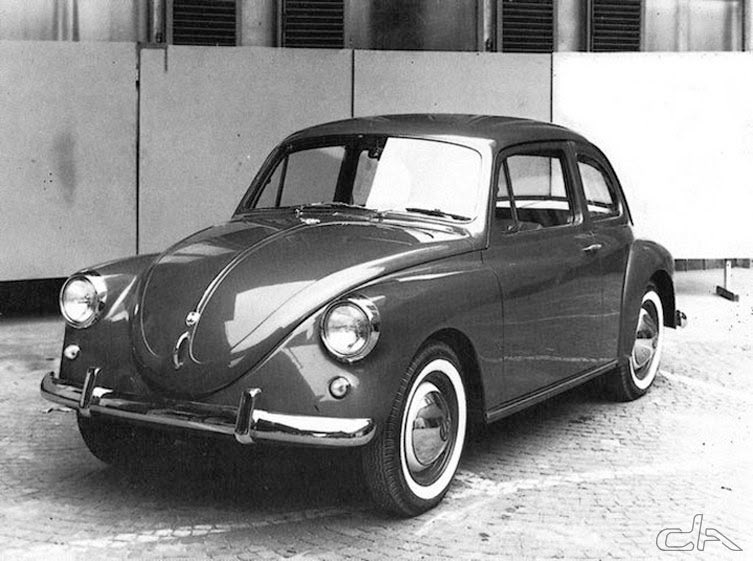
They have been studied and discussed countless times, yet one particular set of images has always held my special attention. These are the photos of the mid-1960s modernized Volkswagen Beetle that never saw the light of day.
This project, known internally as EA 97/1, shows what the future of the legendary “Beetle” could have looked like — but ultimately never did.
To understand the context, it’s worth remembering that the Volkswagen Beetle’s fundamental design was finalized back in 1938. By the mid-1950s the car already looked frankly outdated. Automotive design had evolved dramatically over the intervening decades, and the narrow body, separate fenders, and distinctive sloping-roof silhouette no longer matched the fashion of the time — even though it was precisely then that the Beetle began to develop its own recognizable character.
Volkswagen noticed that Beetle sales were beginning to slow, especially in export markets. It became clear that a car with late-1930s styling needed an update.

It’s enough to look at the prototype photos to understand how serious the redesign was. Although the car is instantly recognizable as a Volkswagen Beetle, it looks significantly more contemporary and much closer to vehicles from the late 1950s to early 1960s. The running boards disappeared, the body became wider and more integrated.
The project was led by Rudolf Ringel from Volkswagen’s advanced development and prototyping department. Designers Luigi Segre and Sergio Sartorelli from the famous Italian coachbuilder Ghia were brought in. By that time, the Ghia–Volkswagen partnership was already well known thanks to the Karmann Ghia, which was built on standard Beetle running gear.
The developers faced entirely practical tasks. They wanted to turn the car into a proper monocoque structure instead of the previous unusual combination of semi-unitary body and platform chassis.
In addition, they planned to increase interior space, improve visibility, enlarge the windows, and give the car a modern appearance so it wouldn’t look like a relic from the pre-war era next to models such as the Rambler, Renault Dauphine, or Toyota Crown. The new Beetle was scheduled to debut at the Frankfurt Motor Show in September 1965.
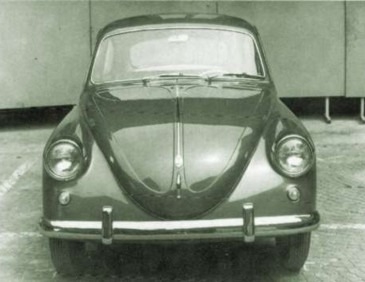
According to available information, at least two full-size design mockups were built with minor differences. They varied slightly in appearance: one featured sloping Hella headlights with dual lenses, typical of early Beetles, while the second received more upright headlamps reminiscent of both the updated 1968 Beetle and the Volkswagen Type 3 that appeared in 1961.

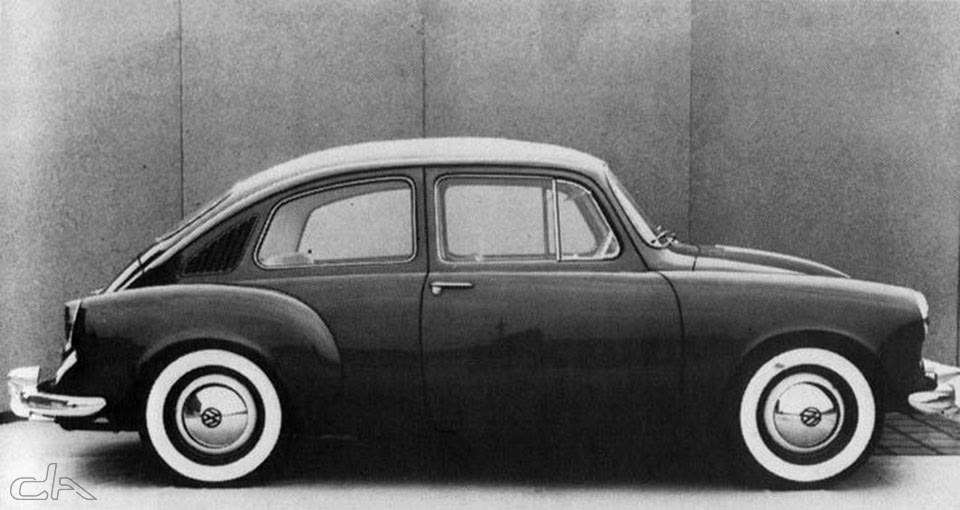
What makes this project especially interesting is the attempt to preserve the recognizable character of the original Beetle while modernizing it. Today we would call this approach retro design, although the term didn’t exist in the late 1950s.
The designers faced a difficult challenge: create a car that fit the spirit of the 1960s while retaining the model’s distinctive features. That’s why they kept the recognizable hood stampings, the characteristic engine lid, hints of separate fenders, and the signature sloping roofline. Despite the changes, the car still reads unmistakably as a genuine Beetle.
Had this car actually appeared in 1965, it would still have looked somewhat dated. It was more of a 1930s car modernized in a late-1950s style than a true mid-1960s product. This is understandable: the project had begun back in 1957.
The most surprising part was not how the car looked, but how far the development had progressed. The EA 97/1 project received official approval from the Volkswagen board of directors. The company even ordered production tooling and built ten pre-production prototypes. According to the book *Volkswagen Raritäten*, there may have been several dozen.
However, two events combined to kill the project’s future.
First, sales of the standard Beetle unexpectedly surged, exceeding management’s expectations. The urgent need to replace the model vanished. Moreover, the new car would have been significantly more expensive both to build and in terms of retooling the factories. Changing a model that was already selling extremely well proved economically unattractive.
Second, in 1965 Volkswagen acquired Auto Union from Daimler-Benz. This purchase would later define the company’s technical direction in the post-Beetle, post-air-cooled era. After the acquisition, management decided not to invest additional resources in an aging model and shifted focus to new directions.
As a result, the project was definitively canceled just six months before its planned debut.
It’s somewhat regrettable that this car never reached the roads. At the same time, it is remarkable that the classic Volkswagen Beetle continued to be produced with virtually no fundamental changes right up until 2003, remaining at its core a late-1930s design.
While most cars are completely redesigned every few years, the Beetle became famous precisely for its astonishing conservatism, which became part of its character. If in 1975 someone wanted to buy a new car with separate fenders and running boards, there was practically no alternative to the Beetle.
Furthermore, the decision to stick with the old body-on-platform construction played another important role in automotive history. Because the body was attached to the platform with just a few bolts, owners could easily remove it and build their own vehicle.
This is exactly why the legendary Meyers Manx, Brubaker Box, and countless other Volkswagen-based kit cars and buggies appeared. Had the Beetle become a full monocoque car in the 1960s, this vibrant automotive subculture would likely never have emerged.
Therefore, despite all the appeal of this unrealized project, it is possible that Volkswagen’s caution and reluctance to take risks ultimately worked in its favor. Sometimes a slight lag behind competitors turns out to be the wisest decision — no matter how strange that may seem today.